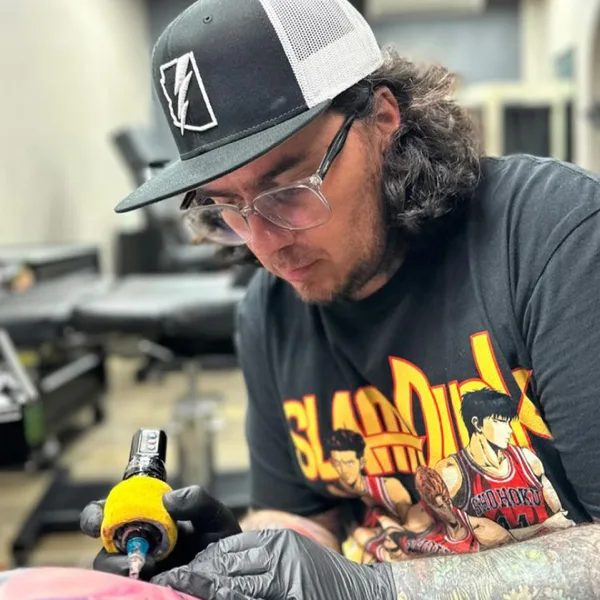
Juan Del Pino has been tattooing professionally for over a decade, but he approaches every piece like it's his first. "The moment you think you've mastered it," he says, "you start cutting corners."
The Road from Santiago to Whyte Avenue
Juan grew up in Santiago, Chile, drawing obsessively from childhood. His path into tattooing came through portraiture — he was painting photo-realistic portraits in oil before he ever picked up a tattoo machine. "The translation was natural," he explains. "Skin has texture, just like canvas. You learn to read it."
After years building a reputation in South America, Juan made the move to Edmonton — drawn by the city's creative scene and, honestly, the winters. "I wanted somewhere that forced me to stay inside and work," he laughs.
The Process Behind a Juan Del Pino Piece
A Juan Del Pino piece typically starts weeks before the session. He'll request reference photos, study the lighting, and sketch multiple versions before settling on a composition. By the time the client sits down, every shadow placement and highlight is mapped out.
"Reference photos are everything," he says. "I can work with a bad photo, but a great photo gives me something to chase. The more detail I have to work from, the better I can serve the client."
What Makes a Portrait Tattoo Last
According to Juan, the biggest mistake clients make is choosing the wrong reference. Blurry photos, poor lighting, and low resolution all compromise the final result. If the photo doesn't capture the subject's eyes clearly, the portrait won't either.
The second biggest mistake is placement. Portraits need flat, stable real estate. The outer upper arm is ideal. "Portraits on the calf or foot — I try to redirect people from those. Muscle movement distorts proportions over time. The portrait looks great day one, different by year three."
The portrait looks great day one, different by year three. Placement is a commitment, not just an aesthetic choice.
Juan's calendar fills quickly — book a consultation early if you're serious about a realism piece. The waitlist can run six to eight weeks.